
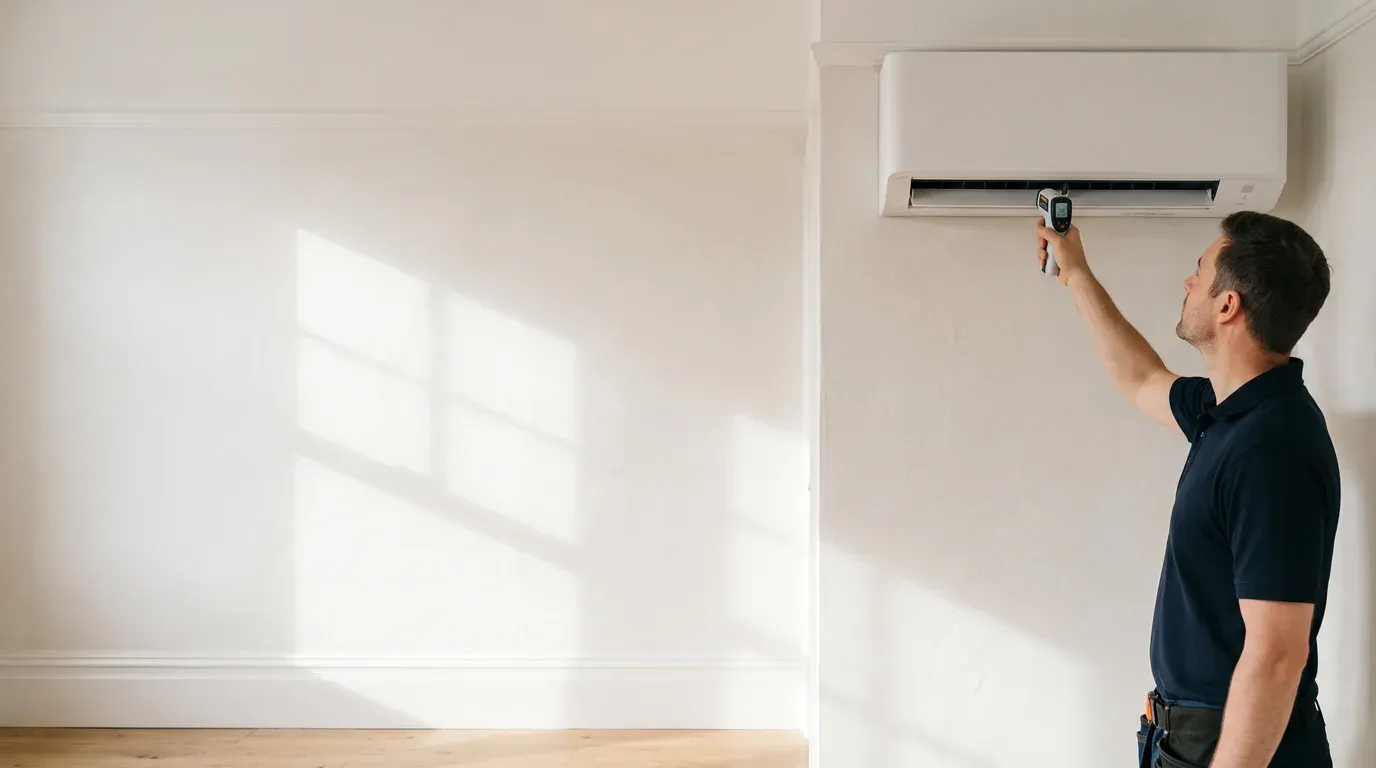
What to Check When Your Air Conditioner Blows Warm Air
When a domestic air conditioner runs its indoor fan but fails to cool the room, it can quickly make your home uncomfortable. Before booking an engineer callout, follow our checklist to rule out common setup issues:
Step 1: Preliminary Homeowner Checks
- Verify Operating Mode: Ensure your remote is set to Cool mode (indicated by a snowflake icon). If it is inadvertently set to “Fan Only” or “Auto”, the compressor may not engage.
- Review Temperature Set-Point: Ensure the target temperature is set at least 3°C lower than the current room temperature.
- Inspect Indoor Air Filters: Lift the front panel of the indoor unit and check the mesh filters. Heavy dust buildup restricts airflow over the evaporator coil, preventing effective heat transfer. Clean them under a warm tap and allow them to dry.
- Check the Outdoor Isolator: Check your electrical consumer unit to ensure the dedicated air conditioning breaker has not tripped. Ensure the rotary isolator switch mounted near the outdoor unit is switched to the “ON” position.
Professional Fault Diagnostics: When to Call an F-Gas Engineer
If the checks above do not resolve the issue, the fault lies within the electrical, mechanical, or refrigeration circuit. Use the symptom guide below to see what is likely happening inside your system and when to call a qualified F-Gas technician:
| What You Notice | Likely Cause | Recommended Action |
|---|---|---|
| Remote shows Fan or Auto icon | System is circulating room air without engaging the cooling compressor. | Switch remote to Cool (Snowflake) mode and set the temperature at least 3°C below room temperature. |
| Weak airflow from indoor unit | Dust buildup on the removable mesh filters is restricting heat transfer across the coil. | Lift the front fascia panel, wash the mesh filters in warm water, dry thoroughly, and refit. |
| Outdoor fan and compressor are completely silent | Tripped outdoor isolator switch, failed compressor run capacitor, or inverter circuit board fault. | Check your consumer unit breaker once; if it is on (or trips again), book an engineer inspection. |
| Outdoor unit runs, but indoor air stays warm | Loss of R32/R410A refrigerant charge from a flare joint micro-leak, or a stuck reversing valve. | Switch the system off to protect the compressor and book an F-Gas pressure and leak test. |
Common Technical Faults We Diagnose:
- Loss of Refrigerant (R32 / R410A): A micro-leak at a flared copper connection or coil joint reduces operating pressures, causing the system to blow ambient air.
- Compressor Run Capacitor Failure: Common on older split systems, a failed starting capacitor prevents the outdoor compressor from starting up.
- Thermistor Sensor Drift: Faulty air-off or coil thermistors feed incorrect temperature readings to the main PCB, cutting the cooling cycle prematurely.
- Inverter PCB Module Faults: Voltage surges can damage inverter power transistors, preventing the compressor from ramping up to speed.
Our £85 Diagnostic Callout Fee Credit
We provide a straightforward, transparent repair service across London, Kent, and Surrey. Our fixed £85 diagnostic callout fee covers thorough on-site electrical, electronic, and refrigeration testing by an experienced engineer.
If you approve our repair quote, 100% of the £85 diagnostic fee is credited directly toward your final repair invoice.
Standard £85 diagnostic callout applies during regular business hours (100% credited toward approved repair). Emergency evening, weekend, and bank holiday appointments carry tiered out-of-hours rates confirmed prior to dispatch.