
Understanding UK F-Gas Legislation & Leak Check Rules
Fluorinated greenhouse gases (F-Gases)—such as R32 and R410A—are regulated in Great Britain under the Fluorinated Greenhouse Gases Regulations 2015, enforced by the Environment Agency and DEFRA.
To prevent harmful emissions, the law mandates that refrigeration and air conditioning systems containing specific quantities of refrigerant undergo regular leak inspections by certified personnel.
Statutory Thresholds: Domestic vs. Commercial
Refrigerant thresholds are calculated by multiplying the physical gas charge (in kilograms) by the gas’s Global Warming Potential (GWP) and dividing by 1,000, expressing the result in tonnes of CO₂ equivalent (CO₂e):
| Refrigerant Type | Global Warming Potential (GWP) | Minimum Charge for 5t CO₂e | Typical System Size | Mandatory Statutory Logbook? |
|---|---|---|---|---|
| R32 | 675 | 7.41 kg | Large commercial multi-split / VRF | Exempt for standard domestic homes (typically 0.8–1.2 kg charge). |
| R410A | 2088 | 2.39 kg | Medium 3-room multi-split | Required if system charge exceeds 2.39 kg. |
Statutory Guidance for Homeowners: If you have a standard single-split or twin-split home air conditioner containing under 7.4 kg of R32, your system falls comfortably below the 5-tonne threshold and is legally exempt from mandatory statutory logbooks. However, electronic flare leak checks during your annual service are essential to prevent performance loss and protect manufacturer warranties.
Our Certified Leak Detection Protocol
When inspecting systems for suspected leaks, our engineers follow strict Environment Agency guidelines:
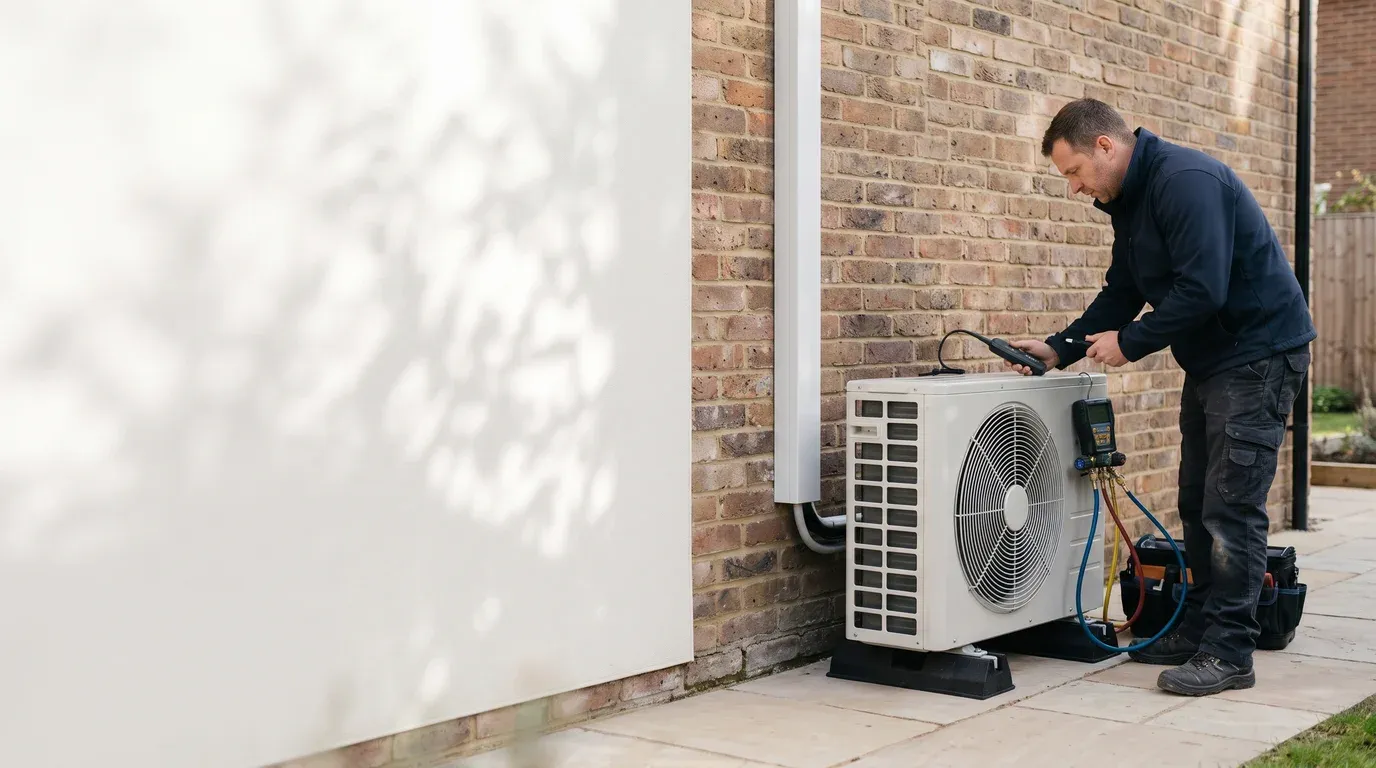
- Electronic Sniffer Testing: High-sensitivity digital refrigerant sniffers calibrated for A2L gases detect micro-leaks down to 3 grams per year around flare nuts and service ports.
- Ultrasound & Bubble Immersion: Suspected micro-fractures are verified using high-viscosity fluorescent micro-bubble testing solutions.
- Oxygen-Free Nitrogen (OFN) Pressure Testing: On systems that have lost pressure, we isolate the circuit and pressure-test with OFN at 38 to 42 bar to locate the fracture before any new refrigerant is introduced.
All leak detection work is carried out by engineers holding City & Guilds 2079 or LCL Awards Category 1 certification, ensuring safe, compliant handling on every visit.