
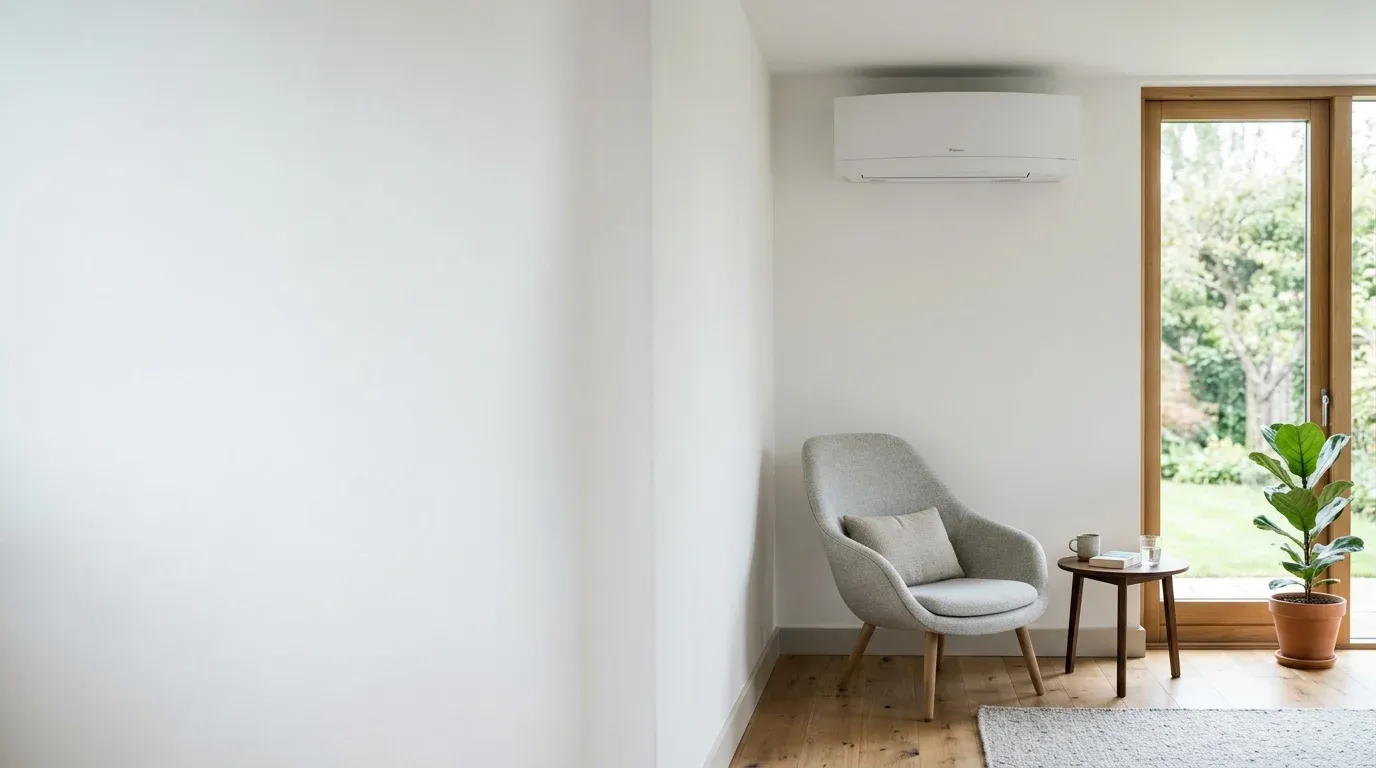
Air conditioning for larger Surrey homes
Surrey housing stock is dominated by detached and semi-detached houses with generous floor areas, and that changes what a cooling system needs to do. A single wall unit in a through-lounge will not condition an open-plan kitchen extension with west-facing glazing, and a system sized on floor area alone will run flat out in August while still leaving the far end of the room warm.
Most of our Surrey work is therefore zoned rather than single-point: a multi-split serving two to four rooms from one condenser, or a small ducted system where the property has a loft void or a service corridor to route ductwork. Where a house has a garden office, annexe or converted garage in separate use, we treat it as its own zone with its own indoor unit rather than trying to push conditioned air down a long duct run.
Postcode areas we cover
| Postcode area | Typical coverage |
|---|---|
| KT | Kingston, Surbiton, Epsom, Ewell, Leatherhead, Cobham, Weybridge |
| RH | Reigate, Redhill, Horley, Dorking, Godstone and the Surrey Hills fringe |
| CR | Croydon borders and the south London fringe |
| SM | Sutton, Cheam and Morden |
Travel times in Surrey are dominated by the A3 and M25 rather than distance, so we schedule surveys by route as well as by diary. If your postcode is just beyond these areas, ask before assuming we cannot reach you.
Where a heat pump earns its keep
Every system we install is a reverse-cycle air-to-air heat pump. In a Surrey house with a large kitchen-diner or a garden office used through the winter, that matters: the same unit that takes the edge off a July afternoon can heat the room in November without a separate electric heater. Air-to-air systems do not qualify for the Boiler Upgrade Scheme. Our pricing guide explains package options and running costs.
Outdoor unit siting in Surrey gardens
Outdoor unit siting catches people out on narrower plots, and in Surrey the more common issue is visual. Homeowners reasonably do not want a condenser facing the lawn from the middle of a herbaceous border. Practical solutions include a screened wall bracket, a purpose-made housing with adequate airflow, or a position behind a garage or side return where the unit is heard less and seen less.
Where a garden office sits at the end of a long garden, the condenser normally goes on the outbuilding itself, with the pipe run kept short and insulated. That is one of the reasons we survey the outbuilding separately rather than treating it as an extra room on the house system.
Planning, conservation areas and trees
Many house installations in Surrey may be permitted development under GPDO Class G, but the conditions depend on the property, the outdoor unit position, noise and any conservation or listed-building restrictions. Surrey is different from much of the country in how often those assumptions need checking: conservation areas, listed buildings, the Surrey Hills National Landscape, and streets where a Tree Preservation Order covers a boundary tree all appear regularly in our surveys.
Read our planning permission guide for the principles and official links.
We check the constraints that apply to your property before confirming a position, and where a planning application or listed building consent is likely we tell you at quotation stage rather than after commissioning. Garden offices and annexes have their own permitted development limits on height and footprint, which we also check when the condenser is going on the outbuilding.
Servicing and planned maintenance
A Surrey system often runs harder than its owner realises, because it is heating in winter as well as cooling in summer. Filters load up faster, condensate traps silt up, and outdoor coils collect leaf litter and pollen through the spring. Our annual service follows a six-point protocol covering filters, evaporator and condenser coils, drainage, refrigerant circuit condition, operating temperatures and electrical safety.
For larger properties with several indoor units we recommend a documented schedule rather than an annual phone call, so that each head is serviced and the whole system is checked as a set. Our maintenance plans set out the intervals and what each visit includes.
Repairs and diagnostics
When a multi-split develops a fault, the symptom often points at the wrong component. A room that stops cooling while others continue is usually an indoor unit issue rather than a system-wide refrigerant loss, whereas every room underperforming at once suggests a condenser or charge problem. We carry the diagnostic equipment to distinguish the two on site, including nitrogen pressure testing for leak tracing.
Our diagnostic callout is charged at a fixed fee and credited against the repair if you proceed. Where a repair is not economic we will tell you, and compare the cost honestly against replacement rather than pushing a new system by default.
Access and access equipment
Larger Surrey houses often mean longer pipe runs, external routes at height, and occasionally a condenser position that needs access equipment. We agree safe access before the day, protect floors and furnishings, and use dust-extracted core drilling so that internal work does not leave a clean room covered in dust.
What happens next
A survey establishes room-by-room heat loads, identifies legal and practical condenser positions, checks the electrical supply and confirms what the price includes. You receive a written price quotation, and nothing is ordered until you accept it. To understand the options first, read the installation service overview or send photographs of the rooms and outside wall through the quote request form for an initial view.