
Cooling Essex homes on new-build estates
A large share of Essex enquiries come from estates built in the last thirty years, and those houses have a predictable set of constraints. Gardens are often compact, side access can be narrow, and the property boundary may be closer to a usable wall than the outdoor unit needs for airflow, access and noise.
That does not make air conditioning impractical, but it does mean the condenser position has to be designed rather than assumed. Common solutions are a high-level wall bracket on a gable, a position behind a garage or side return, or a ground-mounted unit on anti-vibration feet set back from the fence line. What we will not do is fit a condenser that discharges across a neighbour’s patio because it was the only wall available on the day.
Postcode areas we cover
| Postcode area | Typical coverage |
|---|---|
| RM | Romford, Hornchurch, Rainham, Grays and the Thurrock fringe |
| IG | Ilford, Barkingside, Woodford and the Redbridge border |
| SS | Basildon, Wickford, Rayleigh, Benfleet and Southend approaches |
| CM | Chelmsford, Brentwood, Billericay, Braintree and the A12 corridor |
We schedule by route, because the A12, A13 and M25 make some short distances slower than they look on a map.
Outdoor unit siting on smaller plots
Many house installations in Essex may be permitted development under GPDO Class G, but the conditions are not optional. The property, the outdoor unit position, noise and any conservation or listed-building restrictions all matter. On a modern estate with a small garden, the practical question is usually where the unit can sit without affecting a neighbour or recirculating its own exhaust.
There is a second consideration that rarely appears in planning guidance: where the unit actually discharges. A condenser that blows warm air at a boundary fence close by will recirculate its own exhaust, lose efficiency and run louder. Airflow matters as much as the measurement.
We check the current rules at survey and confirm the position in writing. Read our planning permission guide for the principles and official links.
Estate covenants and management companies
Many Essex estates carry restrictive covenants that go beyond planning law. They may prohibit visible equipment on front elevations, require approval from a management company, or restrict external alterations without written consent. These are private contractual obligations rather than planning conditions, and they are the single most common reason a straightforward installation stalls.
We ask about covenants and any management company at survey stage. If written approval is needed we can supply the specification, dimensions and noise figures that the management company will ask for.
Loft conversions, extensions and home offices
Essex has a high proportion of loft conversions and rear extensions, and both tend to overheat. A converted loft can be the hottest room in the house in July and the hardest to ventilate, because roof windows provide limited cross-flow. A rear extension with a large sliding door and a flat roof has the same problem in a different shape.
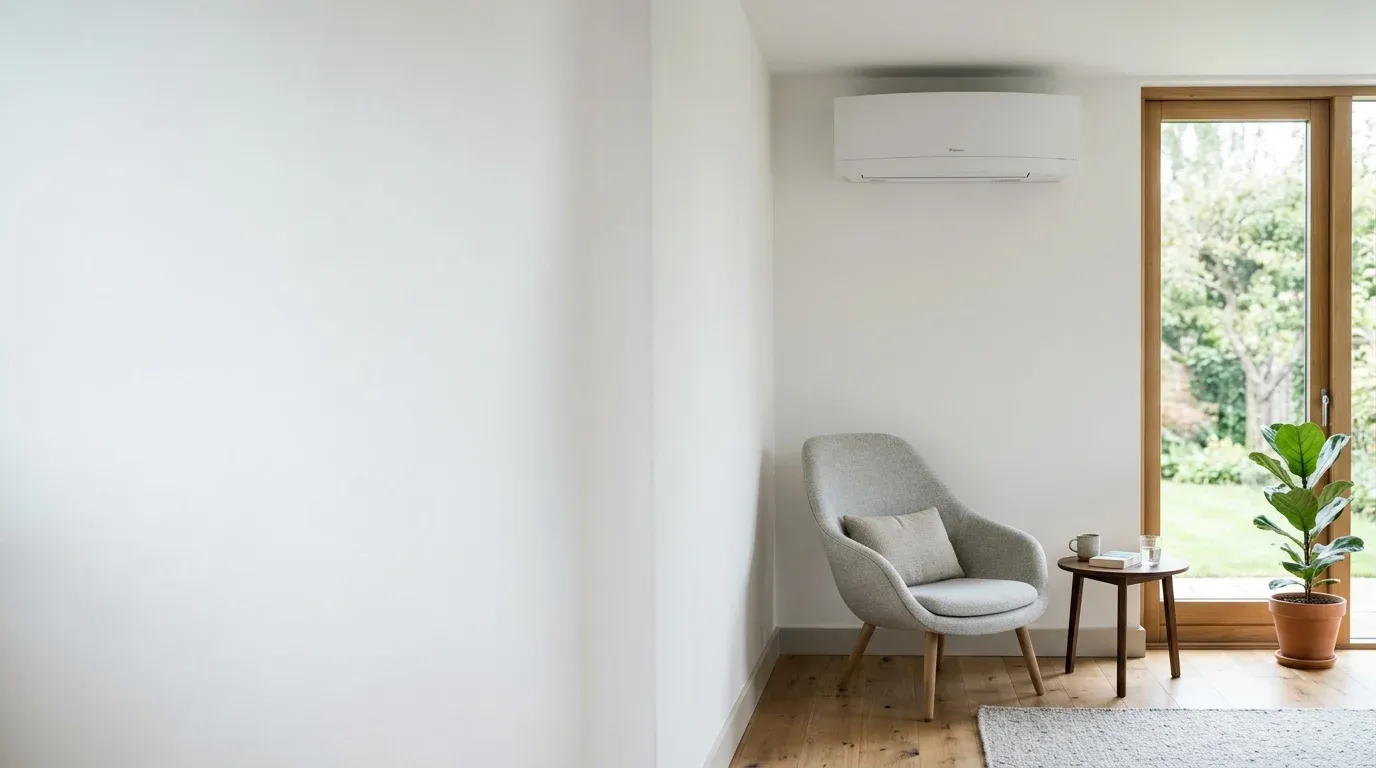
For these rooms a single high-wall unit is often the right answer, sized on the actual glazing and orientation rather than the floor area alone. Where the room is used as a home office through the day, a reverse-cycle heat pump also removes the need for a separate electric heater in winter.
Terraced and semi-detached homes: siting for noise
In older Essex town housing, the sensitive issue is usually neighbour noise rather than boundaries. A condenser mounted on a party wall can transmit vibration into the adjoining property, and a unit facing a shared alley carries sound directly to a neighbour’s door.
We specify low night-time sound units where the position is sensitive, use anti-vibration mounts as standard on wall brackets, and will recommend a ground mount or a repositioned unit where the wall position is likely to cause a problem. It is cheaper to design this out than to argue about it afterwards.
Installation, servicing and repairs
Installation work covers the equipment, the indoor and outdoor mounting, pipework and drainage, electrical connection to a suitable supply, commissioning and handover. Where the electrical supply needs a new dedicated circuit, we explain what the electrical work involves and who carries it out, because the boundary between air conditioning and electrical scope is a common source of surprise in quotations.
Servicing follows the same six-point domestic protocol used across the business, and it matters more on estates where condensers sit close to fences, hedges and bin stores: restricted airflow accelerates coil fouling. Our maintenance plans set out the annual schedule, and the servicing overview explains what each visit covers.
For faults, the repair service covers diagnostics, leak tracing and component replacement. A blocked condensate drain is the most common summer call-out in Essex, usually presenting as water from the indoor unit or a system that cuts out after twenty minutes.
Planning and permitted development
Most house installations may be permitted development, but the conditions are cumulative rather than optional. Flats can also fall within permitted development for planning purposes, but leaseholder or freeholder consent is usually a separate requirement. We check the address rather than assuming, and if consent is needed we say so before you commit to an order.
Conservation areas, listed buildings and Article 4 directions remove or restrict those rights in specific locations.
What happens at survey
We assess room volumes, glazing and orientation, propose indoor unit positions that suit the room rather than the pipe run, confirm a legal and practical condenser position, check the electrical supply, and note any covenant or planning constraint. The output is a fixed-price written quotation with the specification and assumptions stated.
If you want to compare system types first, the installation overview and published prices cover the options. For an initial view, send photographs of the room and the outside wall through the quote request form, and we will tell you what is likely to be feasible before anyone visits.