
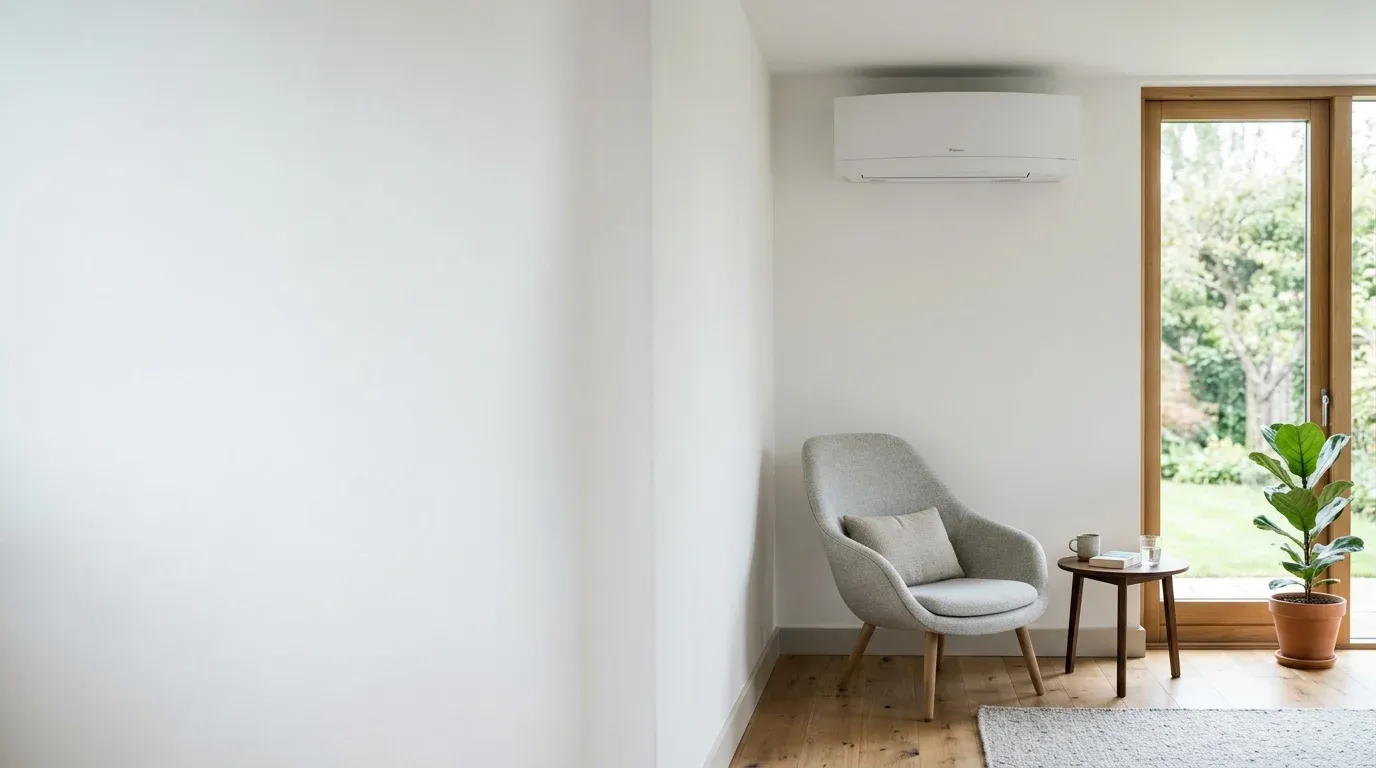
Cooling and heating London homes
London properties overheat in ways that are easy to underestimate. Top-floor conversions sit directly under a hot roof, flats with large south-facing glazing trap heat through the afternoon, and period terraces often have limited cross-ventilation. Because most London homes were built without mechanical cooling, the first sustained warm spell of the year is when most enquiries reach us.
Our London work is almost entirely retrofit. That usually means a single-split system for a bedroom or home office, a multi-split covering two to four rooms from one outdoor condenser, or a ducted unit where wall space is genuinely unavailable. Every system we fit is a reverse-cycle heat pump, so the same hardware provides efficient heating in winter rather than sitting idle for eight months of the year.
Postcode districts we cover
We survey and install across the following London postcode areas. If your district is on the list, we can normally offer a survey within a few working days; if it is just outside, ask anyway, because we regularly travel to the borders.
| Postcode area | Typical coverage |
|---|---|
| SE | South East London, including Greenwich, Lewisham, Bexley and Bromley borders |
| SW | South West London and the Surrey fringe |
| E | East London and the Docklands corridor |
| N and NW | North and North West London |
| CR | Croydon and the surrounding borough |
| SM | Sutton, Morden and Cheam |
Coverage is based on postcode prefixes rather than borough boundaries, because travel time is what determines whether a same-day repair visit is realistic.
Installation in London flats and houses
Flats need the most careful planning. A flat can fall within permitted development for planning purposes, but you will usually also need freeholder or managing-agent consent before an outdoor unit is fixed to a wall, balcony or roof. We ask for that consent early, because discovering a head-lease restriction after equipment has been ordered is expensive for everyone.
For houses, many installations may be permitted development under GPDO Class G. The conditions depend on the property, the outdoor unit position, noise and any conservation or listed-building restrictions. We check the current rules at survey and confirm the position in writing rather than assuming.
Read our planning permission guide for the principles and official links.
Where the outdoor unit goes
In dense areas the condenser position drives the whole design. Rear gardens, side returns, flat roof sections and discreet balcony positions are all workable, but the unit needs unobstructed airflow and must not discharge directly at a neighbour’s window or seating area. Where noise is a genuine concern we specify units with low night-time sound pressure and, where needed, anti-vibration mounts and acoustic screening.
Pipework, drainage and making good
Internal pipe runs are boxed in or routed through service voids, and condensate is drained to a suitable waste or to an external soakaway. In period properties we plan routes around lath-and-plaster walls and original cornices, and we make good afterwards rather than leaving a hole for someone else to deal with.
Servicing and maintenance in London
An annual service is the difference between a system that lasts fifteen years and one that develops a blocked drain, a fouled coil or a refrigerant leak at year five. Our domestic service follows a documented six-point protocol covering filters, coils, condensate drainage, outdoor coil condition, operating temperatures and electrical safety.
London systems also collect more airborne dust and pollen than most owners expect, and flats with restricted airflow benefit from a deep chemical clean every few years. Maintenance plans are available for households that would rather have the visit diarised than remember it themselves.
Repairs and diagnostics across London
When a system stops cooling, the cause is usually one of a small number of faults: a blocked condensate drain triggering a safety cut-out, a failed capacitor or inverter board, a dirty condenser coil, or a refrigerant leak at a flare joint. We attend with manifold gauges, a nitrogen test kit and diagnostic equipment so the first visit can normally confirm the fault rather than guess at it.
Our diagnostic callout fee is fixed and is credited in full against the repair if you go ahead, so the diagnosis is not wasted money. Where parts are needed we quote before ordering, and we tell you honestly when a repair is not economic compared with replacement.
Access, parking and building logistics
London access is its own discipline. We check parking restrictions and any suspension requirements before the day, allow time for lifts, stairwells and communal corridors, and use dust-extraction core drilling to keep disruption contained. Where a building has a concierge or a booking system for contractors, we work to it.
For managed buildings we can supply method statements, risk assessments and public liability documentation in advance, which is often a condition of site access.
What a survey covers
A survey is a technical assessment, not a sales visit. We look at room volumes, glazing, orientation and insulation, identify the likely indoor unit positions, confirm where the condenser can legally and practically sit, and check the electrical supply. You receive a written fixed-price quotation with the equipment specification, what is included, and the assumptions behind the price.
If a system is not the right answer for a particular room, we will say so, including where a simple ventilation or shading measure would solve the problem for less money.
Choosing an installer in London
The market is full of subcontractors and lead-generation intermediaries. We are a family-run business, the people who survey your property are the people who install and service the system, and there is no call centre between you and the engineer. Refrigerant work is carried out in line with F-Gas regulations, and every installation is commissioned and handed over with operating instructions rather than left running untested.
If you would like to compare options, our installation service and published pricing guide set out what a typical London job involves before you speak to anyone.