
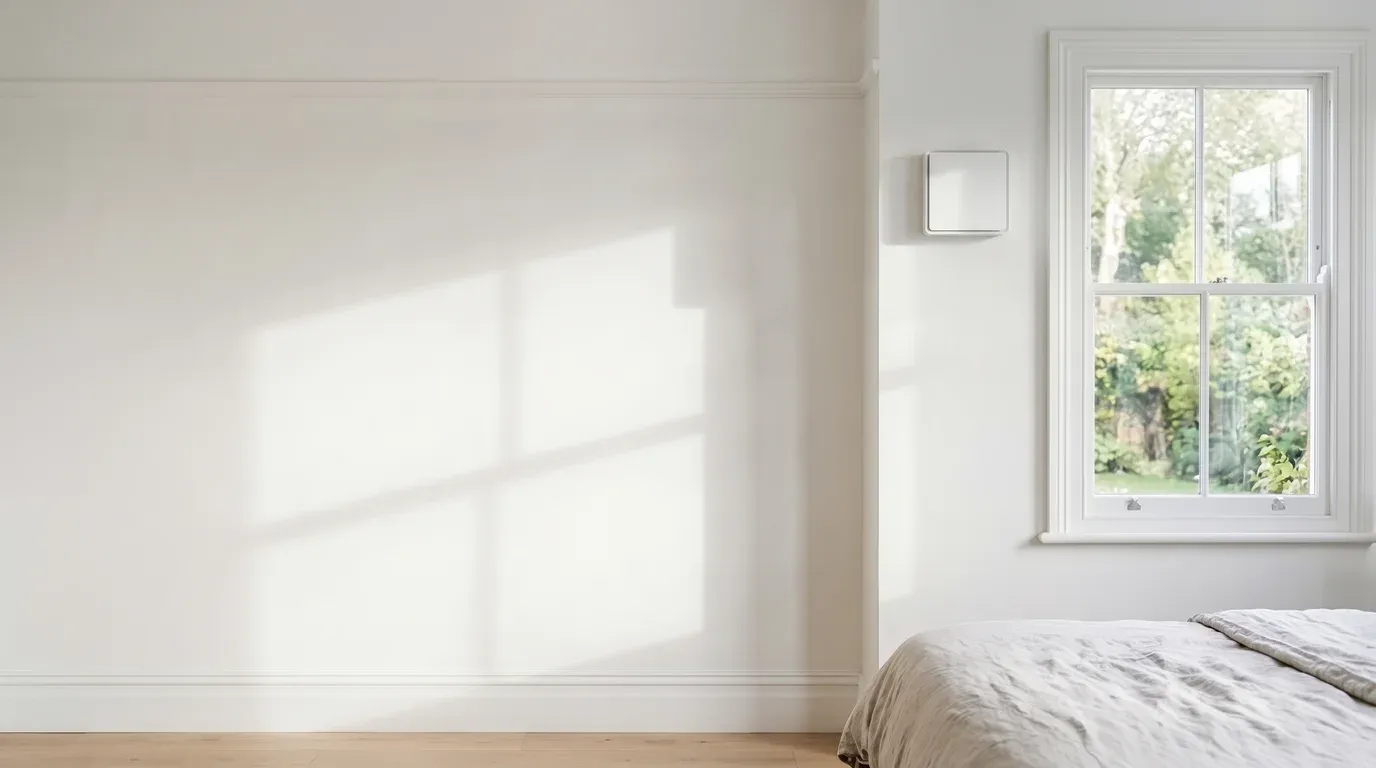
What Is Decentralised Heat Recovery Ventilation (d-MVHR)?
Modern double glazing, loft insulation, and draught-proofing make UK homes thermally efficient in winter, but they also seal in everyday moisture from breathing, showering, and drying laundry. Standard extractor fans expel warm air straight outside and pull freezing draughts back into your home.
Decentralised Mechanical Ventilation with Heat Recovery (d-MVHR) solves this in individual rooms without requiring ceiling ductwork. Installed directly through an external wall, a single-room d-MVHR unit continuously exchanges stale, humid indoor air for fresh, filtered outdoor air while capturing up to 90% of the warmth inside a high-efficiency ceramic heat exchanger core.
How Through-Wall Ceramic Heat Recovery Works
Single-room heat recovery units (such as Blauberg Vento, Vent-Axia, and EnviroVent systems) operate using an intelligent alternating or twin-flow cycle:
| Operating Phase | Airflow Action | Thermal & Air Quality Benefit |
|---|---|---|
| Phase 1: Warm Air Extract (70s) | Stale, humid room air is drawn out through the cellular ceramic regenerator core. | The ceramic matrix absorbs and stores up to 90% of the heat energy from the outgoing air. |
| Phase 2: Fresh Air Supply (70s) | The brushless EC fan reverses to draw fresh outside air through filters and the warm ceramic core. | Incoming fresh air is pre-warmed to near room temperature before entering your bedroom or living space. |
| Humidity Sensor Automation | Integrated hygrometers monitor indoor relative humidity (RH%) 24 hours a day. | Automatically boosts extraction whenever humidity rises above your chosen threshold. |
Key Applications: Retrofit Mould Control & Quiet Bedrooms
Because decentralised heat recovery units require only a single core-drilled wall penetration and no ceiling voids, they are ideal for existing residential properties:
- Bedrooms & Street-Facing Rooms: Supply fresh oxygenated air all night at whisper-quiet sound levels (down to 11–19 dB(A)) while keeping windows securely closed against traffic noise, pollen, and pollution. Combine d-MVHR with our bedroom air conditioning guide strategies for complete sleep comfort.
- Condensation, Damp & Black Mould Prevention: Permanently lowers indoor relative humidity in Victorian terraces, ground-floor flats, and basements, stopping window condensation and toxic black mould growth at the root cause.
- Home Offices & Garden Rooms: Prevents carbon dioxide buildup and stuffiness during long workdays without losing winter heat. Read our garden office climate guide for workspace heating and ventilation tips.
Rapid, Dust-Free Single-Day Installation
Our engineers install decentralised heat recovery units cleanly inside occupied homes with minimal disruption:
- Precision Diamond-Core Drilling: Using M-Class HEPA dust-extracted core rigs, we drill a single 160 mm telescopic duct opening through the external masonry wall at high level.
- Weatherproof Exterior Cowl & Acoustic Sleeve: We fit an insulated acoustic wall sleeve on a slight outward gradient alongside a discreet external weather hood.
- Concealed Electrical Spur & Smart Pairing: Units consume as little as 2 to 5 watts of electricity and can be linked in synchronized pairs via Wi-Fi so one unit supplies while a second unit extracts.
Building Regulations Part F Compliance & Free Survey
All d-MVHR installations installed by Nida Climate Systems are calibrated to comply with UK Building Regulations Approved Document F (Ventilation). Explore our running costs and energy efficiency guide or request your free ventilation survey across London and Kent.